


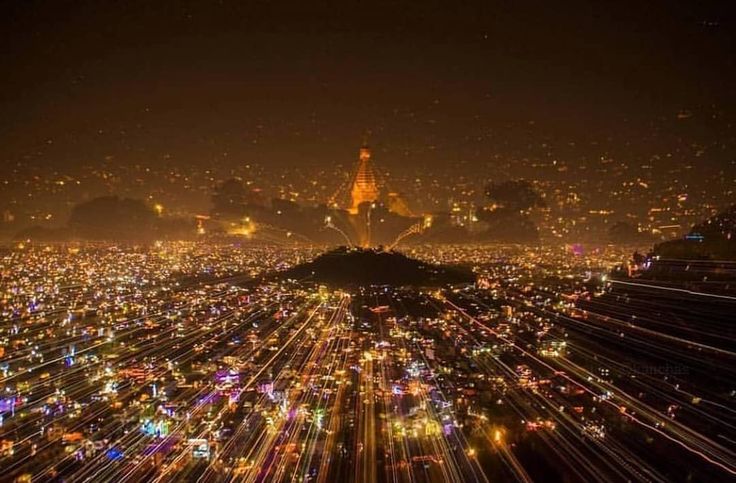
As a kid, I spent every Tihar driving around Kathmandu, watching the city glow. Homes, shops and entire buildings were adorned with light. I always admired the beautiful sight in front of me. It took years to understand that the lights we hang in hope for a prosperous year ahead come at a cost we rarely see.
The lights significantly alter our nighttime ecology.
So, what is light pollution?
Light pollution is a human-made alteration of outdoor light levels. Increased use of artificial light has significantly altered our nightscape. This trend is likely to accelerate in the future, supported by lowered production cost and increase usage of artificial light. It is recognised as a significant anthropogenic environmental pressure (Gaston et al., 2021).
How we celebrate Tihar does contribute to light pollution. Research showed that during festivals, there is a significantly higher night light intensity (Ramírez et al., 2023). The increased use of artificial light for longer hours and in a bigger spatial scale than usual during Tihar increases our annual light intensity.
Why is light pollution a problem?
The consequences of light pollution have been documented at different levels, from individuals to communities and economic functioning, and in different places, from urban to rural and key biodiversity areas of the world (Garrett et al., 2020; Ramírez et al., 2023)
Light pollution has been shown to impact both plants and animals. Prolonged exposure to artificial light prevents many trees from adjusting to seasonal variations. This has implications for the wildlife that depends on trees. Research has shown that light pollution alters behaviours and breeding cycles of insects, turtles, birds and other wildlife species in both urban and rural settings. For example, Lewanzik and Voigt 2014 study showed that artificial light limits the foraging behaviour of Sowell's short-tailed bats to areas with limited light (Lewanzik & Voigt, 2014). This limited foraging behaviour ends up limiting long-range pollination. Furthermore, deaths of seabirds have also been linked to light pollution as it causes disorientation and confusion when flying, leading to hitting the light itself or infrastructure (Rodríguez et al., 2017).
Light pollution also impacts human health. In the short term, it can cause eye sensitivity and headaches. However, in the long run, it has severe health effects. Research has found an association between indoor artificial nighttime light and health problems such as breast cancer (Chepesiuk, 2009). Exposure to artificial light doesn't cause the problem; however, disruption of the circadian clock, the 24-hour day/night cycle, and neuroendocrine physiology caused by artificial light can cause accelerated tumour growth (Chepesiuk, 2009). Disruption of the circadian clock is also linked to other disorders in humans, including insomnia, depression and cardiovascular diseases.
What can we do about it?
Understanding light pollution, and the part Tihar celebrations can play in it, does not mean we have to give up the festival. Tihar is only one contributor among many, alongside electronic advertising, streetlights, decorative lighting, and the excessive illumination of homes and factories.
There are two ways we can adapt our daily lives and Tihar celebrations to reduce light pollution:
Choose gentler lighting for decoration. Use diyos and candles, taking care to manage fire hazards, or switch off decorative lights when going to bed. Lights fitted with timers can do this automatically.
Switch off lights when they are not in use. This applies to all lighting, not just Tihar decorations. Timers and motion sensors can make this effortless.
On a larger scale, cities can adopt dark-sky-friendly streetlights. At present, streetlights often spill light onto nearby homes, gardens, and wildlife habitats. Streetlights should instead use warmer colours, include sensors, and be directed only at areas that need to be lit.
Conclusion
Celebrating Tihar and protecting the night sky are not opposing goals. With small, mindful changes at home and thoughtful planning of our cities, we can keep the festival's flow while preserving the darkness that people, wildlife and ecosystems depend on.
So, this Tihar, let us light our home with care!
References
Chepesiuk, R. (2009). Missing the dark: Health effects of light pollution. Environmental Health Perspectives, 117(1). https://doi.org/10.1289/ehp.117-a20
Garrett, J. K., Donald, P. F., & Gaston, K. J. (2020). Skyglow extends into the world’s Key Biodiversity Areas. Animal Conservation, 23(2). https://doi.org/10.1111/acv.12480
Gaston, K. J., Ackermann, S., Bennie, J., Cox, D. T. C., Phillips, B. B., Sánchez De Miguel, A., & Sanders, D. (2021). Pervasiveness of Biological Impacts of Artificial Light at Night. Integrative and Comparative Biology, 61(3). https://doi.org/10.1093/icb/icab145
Lewanzik, D., & Voigt, C. C. (2014). Artificial light puts ecosystem services of frugivorous bats at risk. Journal of Applied Ecology, 51(2). https://doi.org/10.1111/1365-2664.12206
Ramírez, F., Cordón, Y., García, D., Rodríguez, A., Coll, M., Davis, L. S., Chiaradia, A., & Carrasco, J. L. (2023). Large-scale human celebrations increase global light pollution. People and Nature, 5(5). https://doi.org/10.1002/pan3.10520
Rodríguez, A., Holmes, N. D., Ryan, P. G., Wilson, K. J., Faulquier, L., Murillo, Y., Raine, A. F., Penniman, J. F., Neves, V., Rodríguez, B., Negro, J. J., Chiaradia, A., Dann, P., Anderson, T., Metzger, B., Shirai, M., Deppe, L., Wheeler, J., Hodum, P., … Corre, M. Le. (2017). Seabird mortality induced by land-based artificial lights. In Conservation Biology (Vol. 31, Number 5). https://doi.org/10.1111/cobi.12900